

On the streets of Beirut, Ram, a 15-year-old refugee, moved between neighbourhoods collecting recyclable materials to make a living. Since arriving in Beirut in 2021, Ram initially attempted to continue his education. Unable to access formal schooling, he enrolled briefly in an NGO programme for refugee children. However, the mounting financial pressures soon made attendance impossible, and he eventually dropped out. At the age of 11, he joined older family members and peers in waste picking to help support his household.
Each day, Ram carried large woven sacks on his back as he walked across neighbourhoods in search of plastic and metal. In the evenings, he returned to scrap traders, who weighed what he had collected and paid him a small amount. During his early experiences, waste picking was especially demanding. Ram worked long hours carrying heavy loads. He was frequently stopped by municipal officers and faced competition from other collectors. He encountered traders who controlled access to waste and pricing. Cuts and injuries were common, especially that he had minimal access to protective equipment or medical care.
Over time, Ram’s experience began to shift. He learned which neighbourhoods offered relatively lower exposure to police harassment. He also developed strategies to navigate competition from more established waste pickers. Gradually, he built informal connections in the market that occasionally offered moments of support and protection. Eventually, he managed to secure a small metal cart, easing the physical strain of carrying sacks on his back and allowing him to collect more materials each day. While these changes did not remove Ram from danger or exploitation, they enabled significant improvements in his daily working conditions and income.
Ram’s story reflects the experiences of many refugee children in Beirut, whose numbers have increased significantly in recent years. It also reveals important insights into how these experiences change over time. This raises broader questions. How do refugee children develop practical knowledge that shapes how they engage with street work? How does learning take place through these experiences? Where does this learning lead children? And what might this mean for how education is understood beyond formal settings? Drawing on ethnographic research with refugee waste-pickers in Beirut, this article examines how learning takes place through work and precarity. It invites us to expand our understanding of education beyond schools and to consider how everyday learning practices can inform more relevant and protective education responses in contexts of forced displacement.
Waste Picking among Refugee Children
In recent years, refugee children have become increasingly involved in collecting recyclable materials from Beirut’s streets, bins, and landfills. Since the Syrian war began in 2011, Lebanon has hosted the highest number of refugees per capita worldwide, with an estimated two million Syrians residing within its borders ((UNHCR, 2021a). Yet Lebanon is not a signatory to the 1951 Refugee Convention or its 1967 Protocol and lacks a national asylum framework to provide legal protection for refugees (Nassar & Stel, 2019). Under these conditions, refugees face restricted access to legal residency and formal employment, rendering everyday living increasingly precarious.
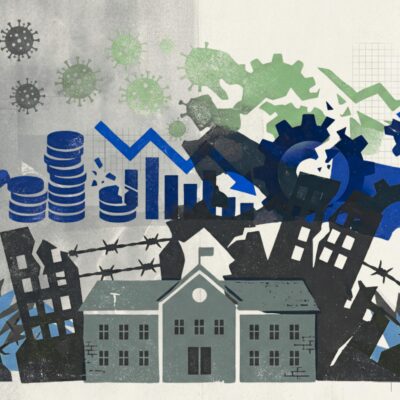
Lebanon’s compounded crises in recent years have further intensified these pressures. The 2019 economic collapse led to currency devaluation exceeding 90% and soaring inflation, while the COVID-19 pandemic disrupted informal livelihood opportunities – particularly as humanitarian funding declined – and the 2020 Beirut port explosion deepened urban hardship. As a result, more than 90% of Syrian refugees were pushed below the extreme poverty line (UNHCR, 2021b). Within this context, many refugee households have been driven into precarious informal livelihoods and hazardous forms of work, with children often playing a central role in sustaining household survival (Habib et al., 2019).
In parallel, the long-running waste crisis in Lebanon intensified. After the 2015 landfill closures and failed contingency planning, waste accumulated in public space, generating environmental and health impacts (Human Rights Watch, 2007). The formal waste sector continued to deteriorate under corruption, privatisation, and state neglect, which led the informal recycling to flourish (Labneh & Facts, 2021). With worsening economic conditions, the market value of recyclable materials increased, incentivising informal collection and accelerating the sector’s growth. Refugee labour filled this expanding economy, providing a cheap and flexible supply while remaining largely invisible to the formal economy. For refugee children, waste picking emerged as a livelihood strategy, especially amid their limited access to formal education. These conditions form the backdrop against which refugee education policies in Lebanon must be contextualised.
Refugee Education in Lebanon
Refugees in Lebanon face restrictions on basic rights, including legal residency and access to formal employment. For children, while compulsory education law formally guarantees access to schooling up to the age of 14, enforcement remains weak. Government responses have nonetheless sought to expand refugee access to education, primarily through the Ministry of Education and Higher Education (MEHE). In 2014, MEHE launched its national education response, Reaching All Children with Education (RACE I), which expanded access through second-shift public schooling, alongside programmes designed to support the reintegration of refugee children into formal education (Hargreaves et al., 2024; Maadad & Matthews, 2020). However, refugee children continued to face significant barriers related to language of instruction, curriculum relevance, and documentation requirements, which constrained meaningful access to schooling.
Building on RACE I, MEHE introduced RACE II, placing greater emphasis on strengthening the educational system more broadly, improving the quality of learning, while easing documentation requirements for school enrolment (IOM & UNICEF, 2014). Despite these efforts, significant limitations persist. For example, refugee youth remain largely excluded from higher education, while access to vocational learning remains limited. NGO-led education programmes largely follow the Lebanese curriculum and are often short-term, fragmented, and weakly aligned with the realities of the labour market. These dynamics have contributed to educational pathways for refugees that remain poorly connected to employment opportunities. Such conditions risk producing what Brun and Shuayb (2020) describe as ‘futureless education’ – schooling that expands participation without enabling credible routes to livelihoods or mobility.
Against this backdrop, this paper explores alternative approaches to education, focusing in particular on work-based learning and its potential to support children’s livelihoods. Drawing on the experiences of refugee waste pickers, it examines how learning unfolds through experiences of work and where such forms of learning lead the children.
Work-based Education in the Context of Displacement
This paper draws on data generated in 2025 through a first prize winning study under the Global Development Awards Competition. The study examined policy pathways for improving the work conditions of refugee waste pickers. It adopted a qualitative ethnographic approach on the streets of Beirut. Data were generated through semi-structured interviews with 30 refugee waste pickers and 10 institutional stakeholders, including representatives from relevant ministries, municipal authorities, NGOs, and environmental and private-sector initiatives. A follow-up focus group with five children consolidated priorities and informed a short documentary which outlines key policy recommendations for improving children’s work conditions. These findings were discussed with practitioners and decision-makers through stakeholder policy dialogues, which in turn informed the educational policy approaches outlined below.
Findings show that while waste picking provided refugee children with a means of livelihood, it also exposed them to extreme forms of violence. Most prominently, children described regular harassment and abuse by municipal authorities. Ahmad commented: ‘The police officers are merciless. They beat us, they detain us, they have no pity’. At the same time, local governance remained selective, as adult scrap traders were largely protected from any interventions, especially given their close connections to political elites. Moreover, children experienced hazardous and physically demanding conditions. They worked for extensive hours and walked long distances across neighbourhoods. They climbed into dumpsters without gloves and protective footwear. They carried heavy weights on their backs, and sustained frequent injuries that often went untreated. As described by Hala: ‘When I pick the metal out of the trash, I cut my hands and sometimes blood runs’. Children also reported coercion and territorial control by intermediaries. Samir explained: ‘Once, a scrap trader hung me upside down for 24 hours on a tree… he made me swear I would work for him exclusively’. Scrap traders made a huge benefit from the children’s supply of recyclable items. They would buy these items from the children in local currency and resell them to private companies or large-scale scrap traders in foreign currency at exponentially higher margins.
To negoitate these challenges, the findings reveal that, over time, children developed work-based knowledge that helped them reduce harm, violence, and exploitation. For example, Fares learned to calculate prices and negotiate deceptions. He explained: ‘I count how many plastic bottles make one kilogram. This way, I can estimate the value of my collected bottles, and the scrap traders will not be able to trick me’. Huda learned how to plan routes: ‘I learned how to read signs on the street. Otherwise, I would be lost’. While these learning experiences, among many others, cannot shield children from systemic exploitation, they demonstrate how work becomes a site of situated learning through which children develop survival strategies, economic reasoning, and negotiation skills. These insights form the basis for rethinking refugee education policy in Lebanon, as outlined in the section below.
Rethinking Refugee Education through Policies on Work-based Learning
Drawing on these findings, this section outlines policy recommendations for education responses that engage with children’s lived realities under conditions of precarity. Rather than treating work and learning as separate domains, education responses must recognise and build on children’s existing practices across different time horizons. In the context of waste picking, on the short term, education can support immediate protection; in the medium term, it can help shift children’s trajectories away from hazardous labour; and in the long term, it can contribute to building more secure futures.
- Short term: Immediate protection
On the short term, work-based learning programmes should provide education rooted in children’s work experiences. In the case of waste pickers, this includes strengthening concrete arithmetic skills such as understanding weights, pricing, and basic calculations, which can help children minimise deception and exploitation by traders. Alongside this, educational programmes can support the development of spatial awareness and negotiation capacities, as well as practical knowledge of the safe use of rudimentary tools, to reduce everyday risks and harm.
- Medium term: Shifting trajectories
On the medium term, work-based education can support transitions away from hazardous labour. Policymakers and implementing partners should establish supervised apprenticeship pathways and vocational trajectories in safer sectors such as mechanics, carpentry, electronics repair, and service-oriented fields such as tourism, alongside environmentally regulated recycling. These measures open pathways toward safer and more stable forms of work.
- Long term: Building better futures
Finally, in the long term, education systems need to recognise the non-linear learning trajectories of refugee children and the interdependence between education, residency, and employment policies. This requires sustained legal reforms that enable secure residency and access to employment, alongside expanded access to vocational and higher education and pathways to dignified work. It also calls for curriculum redesign within formal education systems to ensure that learning can translate into mobility and meaningful employment opportunities.
Critically, these approaches – particularly in the short and medium term – do not seek to normalise child labour. Rather, they acknowledge that immediate withdrawal from work is often unfeasible for families living in extreme poverty under current structural conditions, and that turning a blind eye to child labour allows preventable violence and exploitation to persist. In this paper, work-based learning is therefore proposed as a bridge under conditions of structural exclusion. By engaging with children’s existing learning practices, education can function as a protective mechanism in the present while laying foundations for safer and more equitable futures.
Note
This article is supported by the Global Development Awards Competition – an innovative award scheme administered by the Global Development Network, funded under the Policy and Human Resources Development Fund, managed by the World Bank, and generously supported by the Ministry of Finance, Government of Japan. The views expressed in this documentary are not necessarily those of the Global Development Network or the Ministry of Finance, Government of Japan.
References
Brun, C., & Shuayb, M. (2020). Exceptional and futureless humanitarian education of Syrian refugees in Lebanon: Prospects for shifting the lens. Refuge: Canada’s Journal on Refugees, 36(2), 20–30. https://www.jstor.org/stable/48648689
Habib, R., Ziadee, M., Abi Younes, E., Harastani, H., Hamdar, L., Jawad, M., & El Asmar, K. (2019). Displacement, deprivation and hard work among Syrian refugee children in Lebanon. BMJ Global Health, 4(1), 1–10. https://doi.org/10.1136/bmjgh-2018-001122
Hargreaves, E., Lally, B., Akar, B., Al-Waeli, J., & Costello, J. (2024). Schooling for refugee children. UCL Press. https://doi.org/10.14324/111.9781800086838
Human Rights Watch. (2007). Rot Here or Die There: Bleak Choices for Iraqi Refugees in Lebanon [8].
IOM, & UNICEF. (2014). Lebanese Crisis Response Plan LCRP 2015-16.
Labneh & Facts. (2021, June 3). Plastic Lab: “We love the idea of turning waste into a precious resource.” https://labnehandfacts.com/media/changemakers/rami-ralph-sbeih-plastc-lab-lebanon/
Maadad, N., & Matthews, J. (2020). Schooling Syrian refugees in Lebanon: Building hopeful futures. Educational Review, 72(4), 459–474. https://doi.org/10.1080/00131911.2018.1508126
Nassar, J., & Stel, N. (2019). Lebanon’s response to the Syrian refugee crisis – Institutional ambiguity as a governance strategy. Political Geography, 70, 44–54. https://doi.org/10.1016/j.polgeo.2019.01.005
UNHCR. (2021a). Key figures. Lebanon. https://reporting.unhcr.org/lebanon
UNHCR. (2021b, September 29). Syrian refugees in Lebanon struggle to survive amid worst socioeconomic crisis in decades. https://www.unhcr.org/news/press/2021/9/615430234/un-syrian-refugees-lebanon-struggle-survive-amid-worst-socioeconomic-crisis.html
