




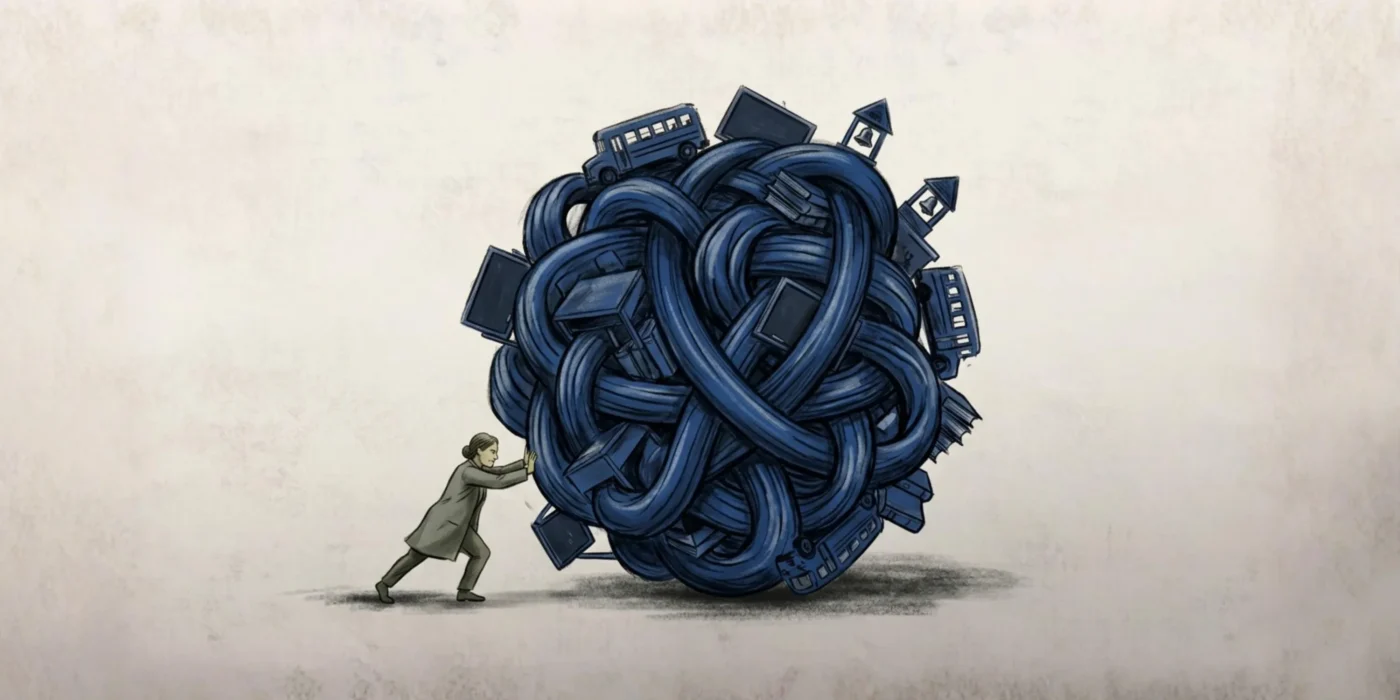
In moments of deep crisis, governments are supposed to become an actual instrument of change, not just a device for managing collapse. In a country like Lebanon, where the education system is experiencing an unprecedented crisis as a result of economic and political collapse, the question becomes even more urgent: can real reform of education be achieved without a clear reform vision for the government?
This question arises strongly when looking at the experience of the current Minister of Education, Dr. Rima Karami, an academic who came to the ministry from an educational and research background at the American University. In terms of academic track, her biography seems to be linked to research on issues of education and educational justice. However, as far as we know, there has been no mention of confrontational attitudes either through word or practice.
The ministry’s practical experience raises a different problem: Is the academic background sufficient to bring about real reform in an education system in crisis? Or does reform need to go beyond theoretical knowledge? From this perspective, is it enough for the minister to be affiliated with President Nawaf Salam’s team to assume that she will work within the reform line?
To understand this problem, we can go back to the thought of the Brazilian educator Paulo Freire, author of the book Education of the Oppressed, who put forward a radical vision of the role of education in society. For Freire, education cannot be neutral; it is either a tool to free people from relationships of control, or a means of reproducing them. Therefore, a true educator is not just a technical expert in education, but a social actor who has the ability to confront structures that produce injustice and marginalization.
Based on this idea, educational reform becomes as much a political, social, and developmental project as it is an educational project. In other words, reform does not happen only through technical plans or policies, but through a clear will to confront authoritarianism and utilitarianism that reproduces the crisis.
From Discourse to Practice
Looking at the current experience in the Ministry of Education, it seems that the gap between reformist discourse and actual practice is still large. Since the minister took office, there has been no clear path to confront the deep structures of the crisis within the ministry. The accumulated corruption files in the sector have not been opened, and decisive steps have not been taken towards holding accountable employees surrounded by suspicions, and there has been no reform in the decision-making structure within the ministry
On the contrary, it seems that part of the ministry’s actual management still relies on networks and advisers who have been associated with former ministers or influential political forces. This reflects the continuity of the traditional mechanisms of work rather than breaking them. This is precisely where the paradox between the reformist discourse and the administrative reality appears.
This paradox is also evident in the relationship with teachers, especially contracted teachers in formal education, where they make up 80 percent of formal basic education. Instead of turning the ministry into a space for real dialogue with teachers as partners in the educational process, policies that are closer to exclusion and marginalization have emerged. Teachers have not been granted basic rights, even in matters of compensation or regular payment. The association that represents them has sometimes been excluded from discussions directly related to their professional destiny.
This style of management is at odds with Freire’s vision of education. Education, in its philosophy, is based on dialogue and participation, and on acknowledging the actors within the educational process rather than treating them as passive recipients of decisions. When educational administration becomes a top-notch process, the educational system becomes closer to what Freire called “banking education,” where decisions are made from above and only others are asked to implement them.
The problem here is not necessarily the intentions, but the nature of the approach. Technical reform alone is not enough to transform an education system linked to a crisis political and economic structure. Real reform requires the ability to confront centers of influence, open corruption files, and build a new relationship with teachers as part of the reform project.
The relationship between teachers and the minister, as well as the relationship between teachers and pupils, can be approached from the perspective of power relations in the educational process. It should be an interactive relationship based on dialogue and engagement. The model provided by the administrator or teacher is directly reflected in the educational practice, because behavior in education is often acquired through simulation. Therefore, if the relationship at the top of the educational pyramid is based on imposition and exclusion, it is difficult for it to turn into a dialogical peer relationship within the classroom.
In this context, Freire explains the concept of indoctrination, which he calls banking, where the teacher treats knowledge as a private property that he deposits in the learner’s mind, without opening the door for dialogue or the development of a critical sense. On the other hand, Freire advocates for a dialogue education in which learners, based on their lived problems, participate in understanding and analyzing topics, enabling them to think critically together and contribute to problem solving.
If we look closely at the relationship between the Minister of Education and contracted teachers, for example, we see practices that are very similar to the application of the logic of banking education. When the correction of the salaries of principals was considered a priority at the expense of correcting the salaries of contracted professors, and when their elected legitimate association was absent from dialogue meetings with decision-makers – as happened, for example, in the meeting of the Minister of Education and the Authority’s ties with the Minister of Finance – it seemed as if trade union issues, wages and rights were a private matter of the ministry and had nothing to do with the professors concerned. Thus, there is no dialogue and active participation in addressing these issues, which are mainly the problems of professors, and they are replaced by a unilateral logic that imposes the decision from the top down.
From the Ministry to the Classroom
Here, a fundamental question arises: How can a teacher who finds himself in an inferior relationship with the educational authority and about his issues, in turn, impart a dialogue education to his students about their issues? And what self-strength does he need in order not to feel oppressed, as Freire calls him, and to become the occupier with the students, and to reproduce the same compulsive logic within the classroom?
The continuation of this cycle deprives education of its primary purpose: to be an experience for freedom, Freire says. Education in which the freedom of the teacher is restricted cannot produce a free-thinking learner, because the quality of education begins with the recognition of the freedom of the teacher and the learner to dialogue, participation and decision-making. Without this freedom, talk of educational reform or critical education is merely a slogan, while in reality it reproduces the same indoctrination inside and outside the school.
Hence, we wonder whether the problem lies in the person of the minister herself, or in the nature of the government in which she came. The government that was presented as a government of reform and rescue was not born out of a reformist social movement, but from the balances of the political system itself. Thus, the ceiling for reform may be limited from the outset. It was no coincidence that the minister was careful not to anger the associations of the authority in exchange for neglecting the demands of the independent association, which represents contracted professors, who are the most vulnerable group. In other words, it took into account the most influential groups and those associated with positions of power at the expense of the marginalized group who do not have a back. This means reproducing educational relations in a way that serves the relations of power.
If the minister seeks to avoid a clash with the parties in power, this undermines the credibility of her role in a government presented as reformist, because reform presupposes confronting the political structures that dominate the ministry’s joints. However, what appears in practice goes beyond simply avoiding confrontation to keeping pace with these forces and adapting to their influence, which was reflected in the speech of receipt and handover, where the minister stressed that the work within the ministry will be based on transcending the past and party and political affiliations, and linking accountability to the quality of performance.
However, practice later showed a tendency to take into account the existing political balances rather than challenge them, through repeated meetings with the Speaker of the House of Representatives, Nabih Berri, and with representatives of the parties under the title of consensus on educational files, which reflected a pattern based on political networking and tacit satisfaction from partisan forces as a result of the absence of public objection or criticism, which turned the management of educational affairs from a reformist discourse to political settlements managed by understandings rather than accountability or structural change.
This was reflected in meeting the demands of some of the associations of the Authority and the principals at the expense of the professors, by approving a special increase for principals from the Council of Ministers, for the first time, which excluded teachers as owners and contractors, which strengthened the influence of the principals in influencing the attitudes of the professors, as most of them are linked to the associations of the Authority. This was also manifested in the overlook of the violation of decisions related to the number of teaching days and the duration of the educational class. 2025, however, the associations contradicted this and adopted 45 minutes, without any disciplinary action or official position from the minister, in light of a negligence and non-collision approach.
In addition, the adoption of controversial educational policies has emerged, including the reconsideration of the 1997 curriculum plan, despite the criticism raised by educators in the past. This also included the decision to allow the contracting of security officers to teach in public high schools, in accordance with the decisions of the Cabinet meeting No. 28/2025 on 16/9/2025, which constituted an educational shock with the minister’s approval of the decision without mentioning any educational standards, which reinforced the predominance of political and clientelistic considerations over educational standards.
With regard to freedom of opinion and expression within the educational sector, the Minister of Education issued Circular No. 12/M/2025 dated 26/2/2025 , which prohibits employees from making any information or statements in the media or through means of communication related to educational and administrative work, limiting this to the Ministry and the directors. The Minister also issued Administrative Memorandum No. 27/M/2026 dated 15/4/2026 It called for an absolute refrain from publishing or circulating any content of a political nature, while obliging professors to delete previous content under penalty of sanctions.
This has raised legal and educational objections, confirming the contradiction between the concept of “absolute abstinence” and the freedom of expression guaranteed by the constitution (Article 13) and within the limits of the law according to the Personnel Law (Article 15). In this context, a decision was recently issued by the State Shura Council to suspend the implementation of the minister’s decision following a complaint filed by the author in partnership with lawyer Dr. Gad Tohme.
At the same time, support for it has declined among a number of partisan and independent MPs, and the circle of objection has widened within the educational body, including among independent teachers. The tension increased because the decision to hold the exams was made without consulting the representatives of the professors and the parents’ committees, who in turn opposed it, which put it in front of students, professors, parents, and a number of independent deputies, before it also lost the support of political forces with which it had sought an understanding.
Repair Ceiling
However, the deeper problem relates to the nature of the relationship with these parties, which in practice have a broad grip on education in Lebanon. Each of them has its own networks of private schools, partisan and sectarian, which constitute an essential part of the educational scene, and in many areas it has succeeded in expanding its influence within the public schools themselves, to the extent that they have turned some of them into something like “educational federations” subject to local partisan authorities.
When the Ministry of Education chooses to keep pace with these forces rather than limit its influence, it is not content with adapting to this reality, but also enshrines it and grants it additional legitimacy within the educational system. The irony is that this reality may be more dangerous than the case of a party minister who has an explicit affiliation, because keeping up with the different poles of power gives them all more space to expand within education rather than limiting their influence.
In the light of Paulo Freire’s thought, education cannot be a space for emancipation if it remains subject to the power relations that produce it; education, he argues, either dismantles or reproduces relations of domination. When the Ministry of Education is managed within the balance of political forces that dominate schools and educational linkages, reform is governed by the ceiling of these balances, and education becomes a tool for reproducing power rather than a space for liberation from it.
An example of this is her first advisor for higher education affairs, Dr. Adnan Al-Amin, who previously wrote about his reform vision for the Ministry of Education, especially the Lebanese University, and in the book “Lebanese University Issues and Reform“, which he co-authored with other researchers and was published in 1999 by Dar Al-Nahar Publishing and the Lebanese Commission for Educational SciencesAl-Amin criticized clientelism and political interference in the administration of the Lebanese University, considering that it contributed to subjecting academic and administrative decisions to the balance of political forces more than they were subject to academic considerations, while after he reached a position in power as an advisor to the Minister of Education, the file of full-time in his administration was recently dealt with away from the standards he was demanding, so full-time employees were selected according to criteria that do not rise to any fair reform approach, the first of which is activating the role of the Lebanese University Council in the field of full-time decision.
In a reading of the full spectacle of the government’s policies, we note the absence of a socio-economic reform vision in the ministerial statement itself and a major confusion in the decisions at this level, the latest of which is the increase in the value of taxes on hydrocarbons, the increase in the value added tax and the subsequent increase.
The experience of the Ministry of Education may be a clear example of the difference between reformist discourse and traditional practice. In the light of Paulo Freire’s thought, the most important question becomes: can a libertarian education be built in a political system that still reproduces the same relations of control? Can a minister, regardless of her academic background, lead a real reform without the social support and social mobility that imposes this reform?
Perhaps the answer lies here: dialogue education is not only made in offices, but is born out of a living relationship between knowledge and reality, between thought and society, between the educator and the social struggle. Without this relationship, the best pedagogical ideas may remain just beautiful theories that don’t find their way into practice. This is in addition to the position of the person in charge: does he dare to confront even at the expense of his position, or does he prefer appeasement in order to preserve this position?

